Best Tools for WhatsApp Order Updates in 2026 for Small Businesses
Your WhatsApp order updates get ignored when they arrive too late or from the wrong number. Manual follow-ups break the moment order volume climbs, and missed delivery pings turn into "where is my order?" messages your team answers by hand. That is usually the point where small businesses start comparing tools.
This article breaks down what order update features actually matter in 2026, then reviews eight platforms, from Com.bot to Wati, on pricing and standout capabilities. You will finish with clear criteria for choosing the right fit and a straightforward pick for most small businesses.
What to Look For in WhatsApp Order Update Tools
Selecting the right WhatsApp order update tool requires evaluating features that balance automation, compliance, and cost-efficiency. Small businesses that ship dozens or hundreds of orders each week cannot rely on manual replies, yet they also cannot afford a tool that risks getting their number blocked.
The right choice depends on three things working together: how well the tool connects to your store, how reliably it sends approved messages, and how clearly it reports on what happened. A weak link in any of these areas shows up fast, usually as delayed updates or frustrated customers.
This section explains the criteria used throughout this roundup. Every tool mentioned later, from WATI and Interakt to AiSensy, Zoko, and the larger API providers, is judged against the same checklist.
Before comparing vendors, it helps to separate two layers of the stack. The WhatsApp Business API is the messaging infrastructure itself, offered through providers such as 360dialog, Twilio WhatsApp, Gupshup, Infobip, and Clickatell. The tool you actually log into each day sits on top of that layer and handles order update automation, templates, and reporting.
Compliance deserves equal weight to features. WhatsApp's rules around opt-in, template categories, and messaging windows apply to every business, regardless of size. A tool that makes compliance easy to maintain is worth more than one with a longer feature list and looser guardrails.
Key Features Small Businesses Need in 2026
In 2026, small businesses should prioritize tools that offer seamless order tracking integration, automated template messages, and robust CRM synchronization. These three capabilities cover the core of what order update automation actually requires.
Real-time order tracking comes first. The tool should pull status changes from your store automatically, whether that happens through a Shopify WhatsApp plugin, WooCommerce order alerts, or a custom webhook integration. Manual exports and CSV uploads do not scale past a certain order volume.
Automated status updates via utility templates are the second pillar. Utility templates cover order confirmations, shipping notices, and delivery updates, and they can be sent outside the standard 24-hour session window. Marketing templates and authentication templates serve different purposes and follow their own rules, so a tool should keep these categories clearly separated.
Two-way communication matters more than many owners expect. Customers reply to order messages with questions about addresses, delivery times, and returns. A tool that only sends messages but cannot route replies back to a shared inbox or support agent creates a new problem instead of solving one.
Analytics and scalability round out the list. Look for delivery rates, read rates, and response times in the reporting dashboard. On scalability, confirm the tool can handle your busy season without message queues backing up or costs spiking unpredictably.
Finally, verify opt-in compliance and policy alignment. The WhatsApp Business Policy requires documented consent before you message a customer, and reputable tools build consent capture into the checkout or signup flow. Meta Business Suite provides the account-level controls, but the tool should make day-to-day compliance straightforward rather than something you remember to check.
- Order tracking integration: automatic sync with your e-commerce platform or a webhook
- Utility template automation: triggered confirmations, shipping, and delivery updates
- Two-way messaging: replies routed to a shared inbox or agent
- Analytics: delivery, read, and response metrics in one view
- Scalability: stable performance during peak order periods
- Opt-in and policy compliance: consent capture and template category discipline
Cloud API versus on-premises API is a related decision. Most small businesses are better served by the Cloud API through a provider, since it removes hosting and maintenance work. The on-premises option mainly suits larger operations with specific data requirements.
Cost structure also belongs on the checklist. Pricing usually combines a platform fee with per-conversation or per-message charges set by Meta, so compare total monthly cost at your actual order volume, not at a demo-level figure. A tool that looks cheap at low volume can become expensive once utility template conversations scale.
Use these criteria as a scorecard as you read the rest of this roundup. Tools that handle high-volume order updates while staying inside WhatsApp's policies will rise to the top, and the ones that cut corners will be easy to spot.
1. Com.bot - Best Overall
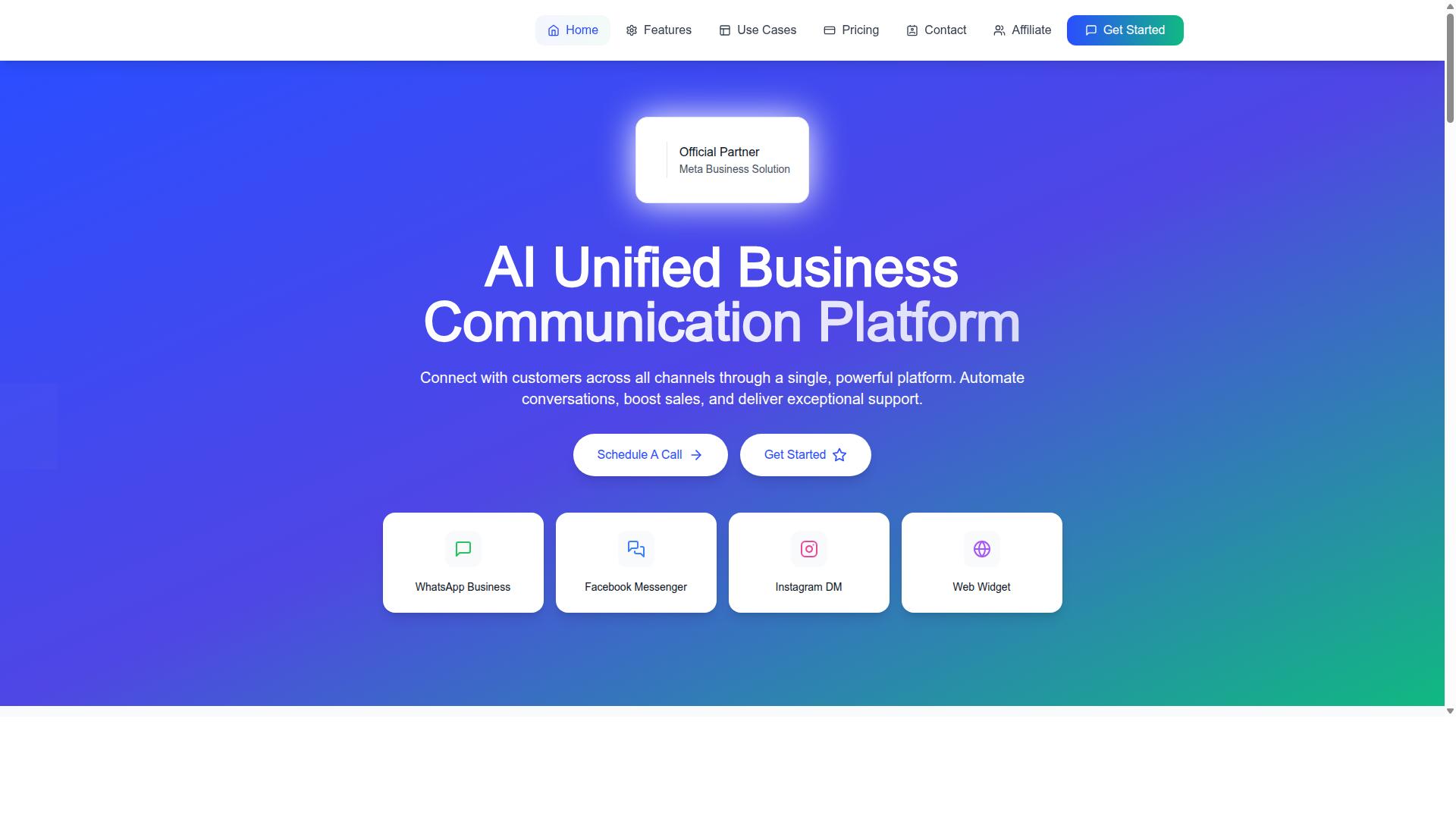
Com.bot stands out as the best overall WhatsApp order update tool due to its comprehensive automation and multi-channel capabilities. It holds official Meta Business Partner status, a distinction that matters for small businesses relying on the WhatsApp Business API for customer communication.
That status means order updates flow through approved infrastructure rather than workarounds. Businesses can send template messages for confirmations, shipping alerts, and delivery notices without worrying about policy violations or unstable connections.
What separates Com.bot from many single-channel tools is its reach. Order updates can go out across WhatsApp, Facebook, and Instagram from one platform, so a customer who messages on Instagram still receives consistent order communication. For small teams juggling multiple storefronts and social inboxes, that consolidation reduces the number of dashboards they need to monitor.
Com.bot also functions as a full conversational commerce layer, not just a notification sender. It combines a Unified Team Inbox, Smart Chatbots, and Payment Collection, which means an order update can lead naturally into a support conversation or a repeat purchase. For a small business, that continuity is often the difference between a one-time buyer and a returning customer.
Order Updates, Pricing & Standout Features
Com.bot automates order updates through its visual bot builder and native payments, with pricing plans starting at $149 per quarter. The drag-and-drop Visual Bot Builder lets teams design update flows without writing code, which keeps setup within reach for businesses without a developer on staff.
Order Updates sit alongside related capabilities that support the full purchase journey:
- Order Updates for status notifications tied to purchases
- Native Payments for WhatsApp transactions
- Bulk Messaging and Notifications for wider customer communication
- Automation Builder with 1000+ integrations
- Multi-Channel Support across WhatsApp, Facebook, and Instagram
- Unified Team Inbox and Team Collaboration with role-based access
Pricing is structured across three tiers in USD. Silver is $149 per quarter, Gold is $349 per quarter and is the recommended plan, and Platinum V1 is $2500 per quarter. Add-ons cost $10 per month for items such as an additional team member, a social channel, external actions per 5000, bot triggers per 25000, and an ecom store. WhatsApp messaging is billed at actual Meta rates with no markup, and dedicated support is available at $49 per hour for WABA, CRM, and Inbox, or $99 per hour for Ecommerce, Bots, and Automations.
The scale behind the platform is notable: 23,000+ active customers and 25M+ messages per day, supported by enterprise security. For a small business, that volume signals a platform tested under real load. Com.bot also extends beyond messaging through Tasks.Bot, Tickets.Bot, and Calendars.Bot, giving growing teams room to expand without switching vendors.
2. Interakt
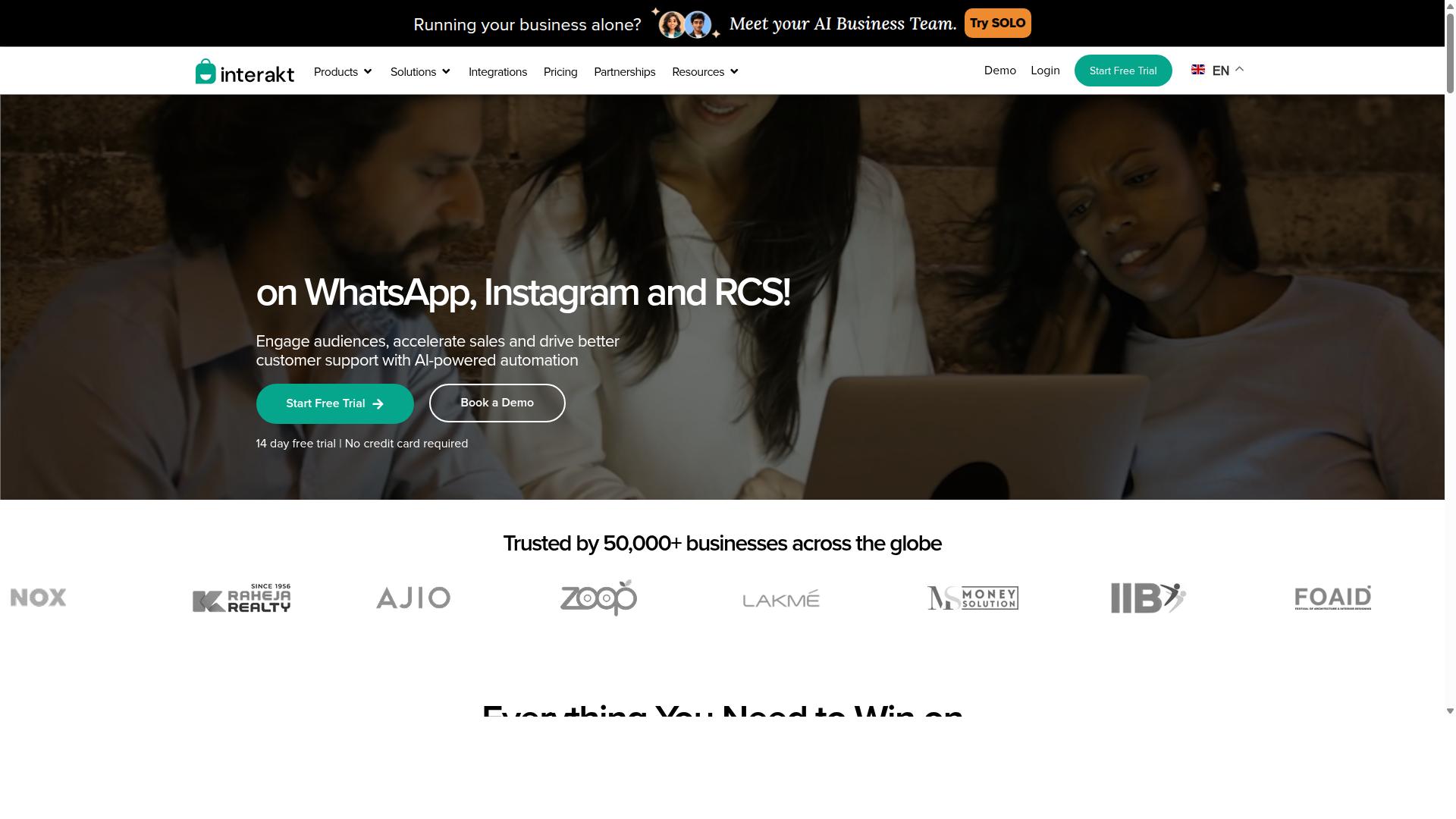
Interakt offers a user-friendly platform for WhatsApp commerce, with strong integration capabilities for e-commerce platforms like Shopify. For small businesses that already sell through Shopify, it can act as a practical layer for sending order confirmations, shipping alerts, and delivery updates without building custom infrastructure.
The tool is built around automating WhatsApp for sales, marketing, and support. That combination matters for order updates because a single customer conversation often moves between a shipping question, a product query, and a repeat purchase. Keeping those threads in one place reduces the chance of missed messages.
Interakt is typically positioned as a Shopify WhatsApp plugin, so setup often involves connecting a store and mapping events such as order placement or fulfillment to message templates. Businesses that run on WooCommerce or a custom stack may find the fit less direct and should check integration options before committing.
On pricing, Interakt publishes tiered plans that start at $21 per month on the Starter Plan, or $180 per year. Higher tiers scale up from there, and WhatsApp conversation charges are billed separately on top of the subscription. Small businesses should budget for both the platform fee and per-conversation costs.
Plan pricing as listed publicly:
| Plan | Monthly | Annual |
|---|---|---|
| Starter | $21 | $180 |
| Growth | $41 | $296 |
| Advanced | $51 | $468 |
| Premier | $99 | $839 |
Order update features often include automated status messages, abandoned cart reminders with checkout links, and COD double-confirmation to reduce return-to-origin rates. These are the kinds of notifications that keep buyers informed and cut down on "where is my order" tickets.
Beyond order alerts, Interakt may offer bulk campaigns, a shared team inbox, auto-replies, chatbots, and AI agents. It also supports Instagram automation and a WhatsApp Blue Tick application, which can help with brand credibility. Larger support teams may appreciate the shared inbox for routing customer replies.
For a small business weighing customer notification tools, Interakt's main appeal is the Shopify-first workflow. Merchants who want to start quickly and stay within one ecosystem may find it a reasonable fit. Those needing deeper custom logic or multi-channel coverage should compare it against other options in this list.
3. AiSensy
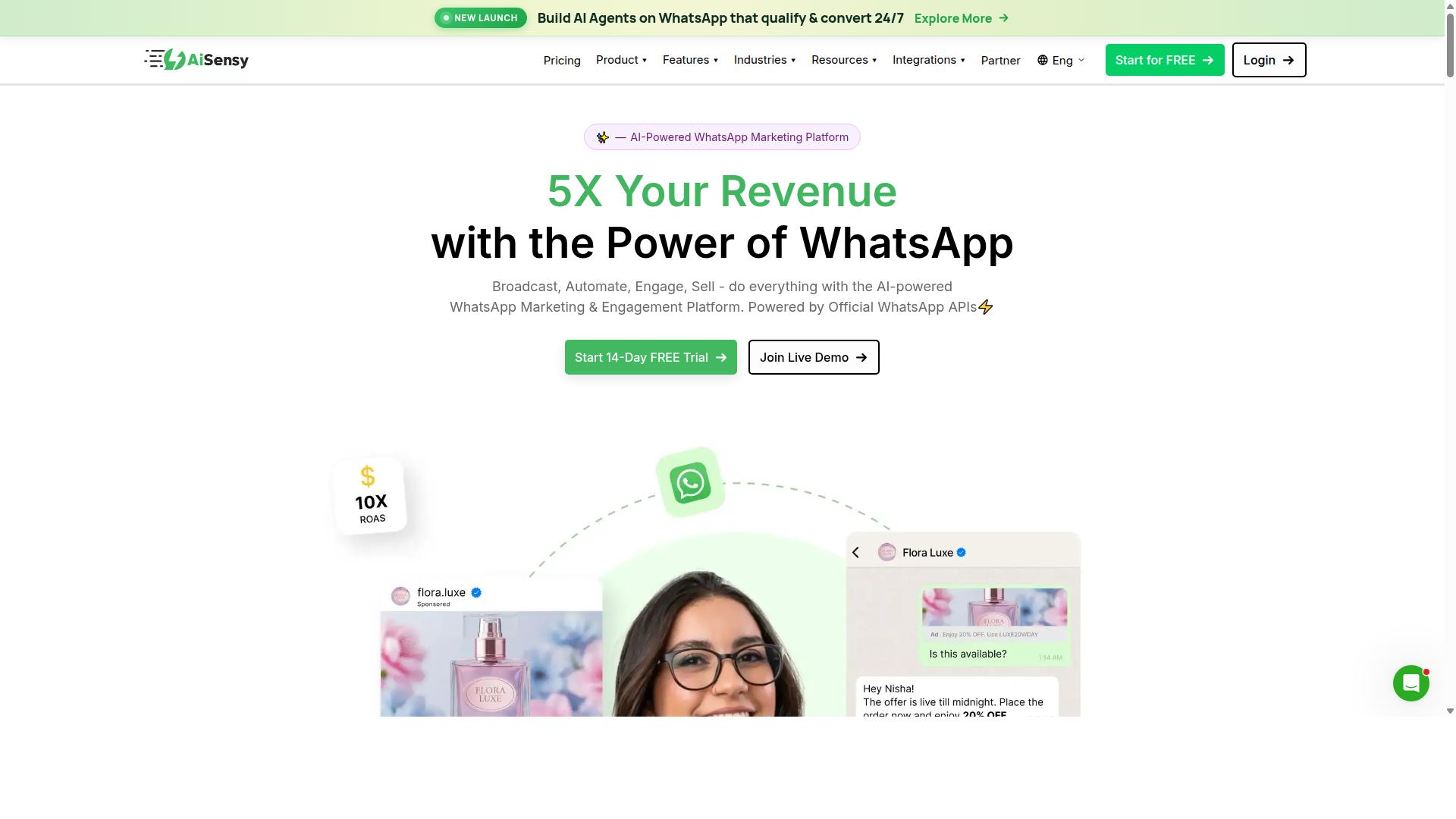
AiSensy is known for its cost-effective WhatsApp Business API solutions, enabling automated order updates and campaign management. It is a no-code platform built on the official WhatsApp Business API, which makes it approachable for small teams that do not want to manage technical infrastructure themselves.
The tool is an Official BSP, meaning it works within Meta's approved framework for business messaging. That status matters for small businesses because it keeps messaging compliant with the WhatsApp Business Policy while still allowing automation at scale.
AiSensy positions itself as a Wati alternative, with a focus on SMBs, D2C brands, and marketing-led WhatsApp use cases. For order updates specifically, that positioning translates into practical tools for sending timely, structured notifications to customers.
Key features for order updates
AiSensy's core strength for order updates is template messages. These pre-approved formats let a business send order confirmations, shipping alerts, and delivery notifications without drafting each message manually.
The platform supports automation flows, so an order status change in a connected system can trigger a message automatically. This reduces the manual effort of updating customers one by one, which is often the biggest bottleneck for small teams.
Campaign management is another part of the toolkit. Beyond transactional updates, businesses can use the same platform for promotional messages, though these typically require separate opt-in compliance and marketing template approval.
- Template messages for confirmations, shipping, and delivery updates
- Automation flows that trigger messages from order events
- Campaign management for marketing and re-engagement messages
- No-code setup suited to teams without developer resources
- Official BSP status for policy-compliant messaging
The AI capability is best described as basic or available through add-on flows rather than a core strength. Businesses that want deep conversational AI may need to look at how it integrates with other tools.
Pricing and who it suits
AiSensy pricing starts at INR 1500/month plus WhatsApp conversation charges, or $45/mo (₹1,500) depending on the plan. A free tier is also available, which can help small businesses test the platform before committing.
Pricing structures in this category change often, and conversation charges depend on message volume and category. Readers should check the official website for current details rather than relying on any single figure.
AiSensy is generally best suited to India budget marketing use cases, where affordability and quick setup matter more than advanced AI features. For a small business sending routine order updates, that trade-off can be reasonable.
When comparing options, weigh template flexibility, automation triggers, and how easily the tool connects to your existing order system. Those factors usually matter more than headline pricing alone.
4. Zoko
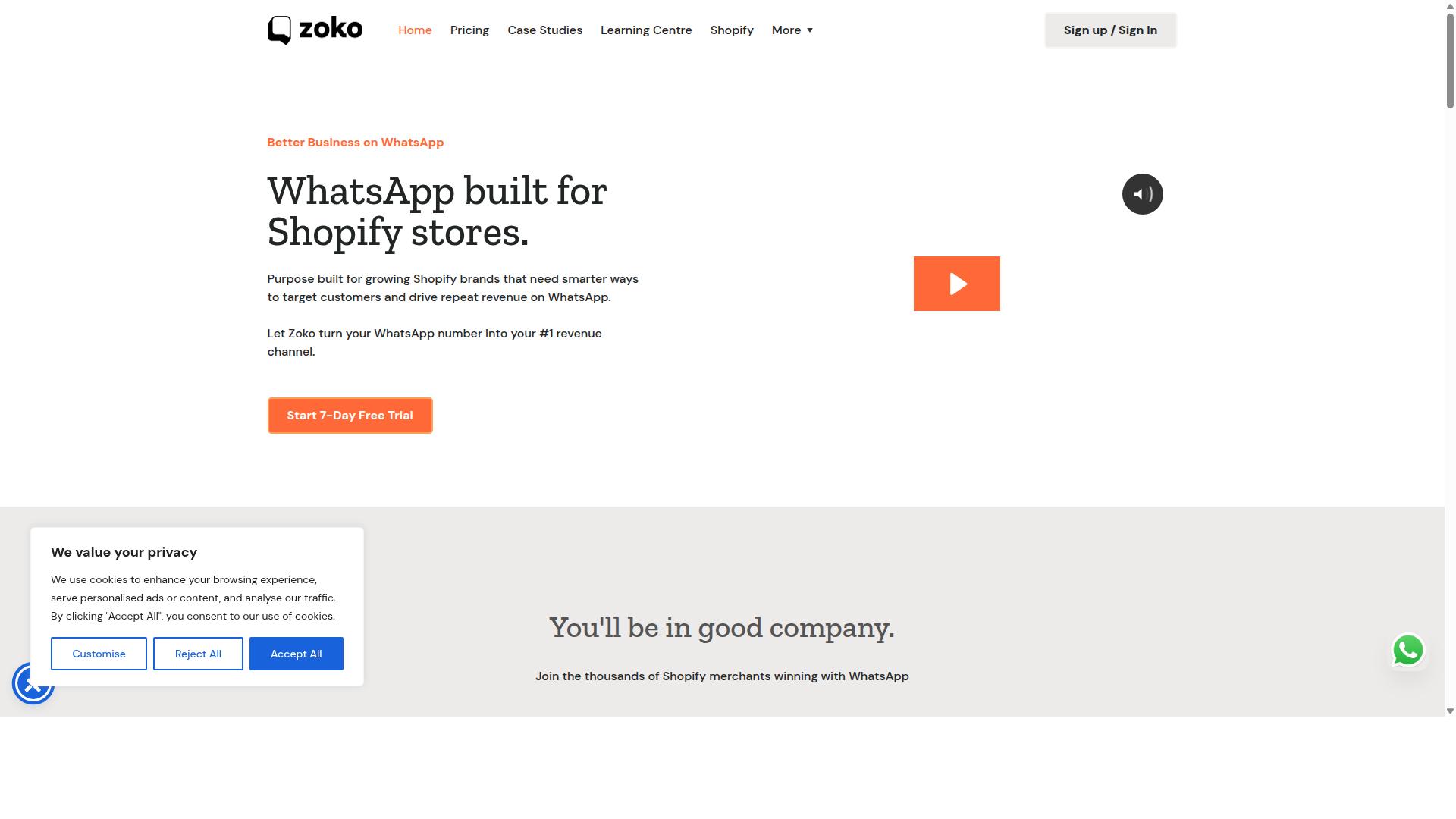
Zoko focuses on conversational commerce, helping businesses send order updates and manage customer interactions on WhatsApp. Rather than treating WhatsApp as a one-way broadcast channel, the platform is built around two-way conversations between a business and its buyers.
That distinction matters for small businesses. An order update is rarely the end of the exchange. A customer who receives a shipping confirmation may reply with a question about delivery timing, a request to change an address, or a follow-up about a return. Zoko's design keeps those replies inside the same thread instead of scattering them across email and social channels.
The platform's core strength is its shared team inbox. Multiple staff members can view and respond to the same WhatsApp conversation without duplicating replies or losing context. For a small team handling orders alongside general inquiries, that shared visibility reduces the risk of a message going unanswered during a busy period.
Zoko also connects with common e-commerce platforms, which allows order events to trigger WhatsApp notifications. In practice, this means a store can send updates when an order is confirmed, packed, shipped, or delivered without manually composing each message.
- Order notifications: updates triggered by e-commerce order status changes
- Team inbox: shared visibility across staff handling the same number
- Conversational commerce: two-way threads rather than one-way blasts
- E-commerce integrations: connections to popular store platforms for order data
Businesses evaluating Zoko should confirm which integrations matter most to their store setup. A Shopify WhatsApp plugin connection behaves differently from a WooCommerce order alerts setup, and the depth of each integration varies by provider. Checking the current integration list before committing is a practical step.
It is also worth verifying how the platform handles template messages versus session messages. Order updates sent outside an active conversation window generally need approved utility templates under WhatsApp Business Policy, while replies inside an open session have more flexibility. Understanding that split helps teams plan message content in advance.
Zoko suits small businesses that want order updates and customer conversations in one place, particularly those already selling through a supported e-commerce platform. Teams that only need one-way notifications may find the conversational layer more than they require.
5. DelightChat
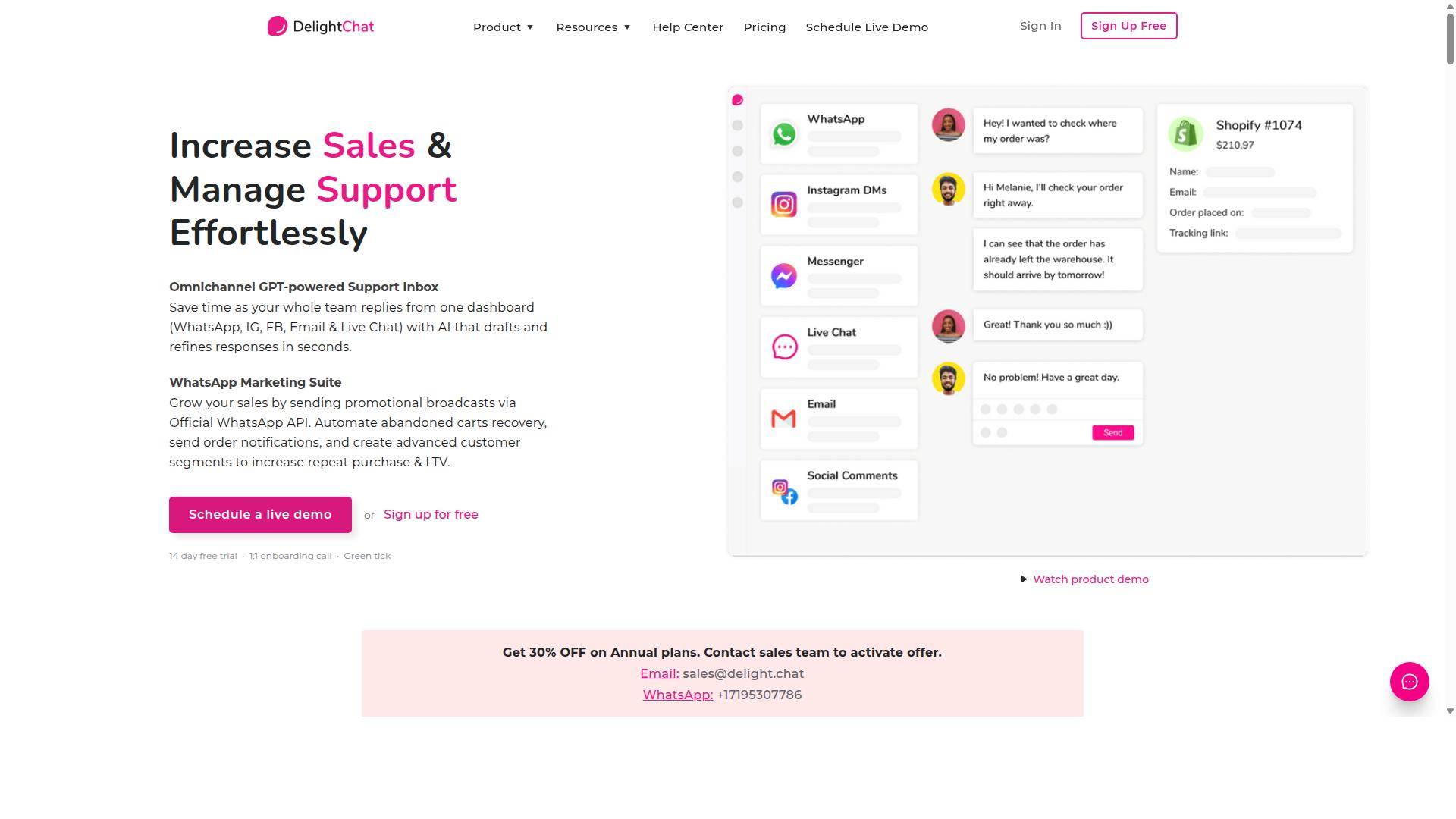
DelightChat provides a shared inbox and automation tools for sending order updates and notifications via WhatsApp. For small businesses juggling multiple conversations, the appeal is straightforward: keep customer chats and order-related messages in one place instead of scattering them across personal phones and spreadsheets.
The platform is generally positioned as a customer support and engagement tool rather than a pure broadcast engine. That means teams can typically handle incoming questions about delivery status, returns, and order changes while also pushing out proactive updates. For a small shop, that combination can reduce the back-and-forth that eats into the day.
When evaluating DelightChat for order update automation, look at how it fits your existing stack. The most useful setups connect a storefront, such as Shopify or WooCommerce, so order events trigger a message without manual work. If your workflow depends on order tracking integration, confirm which platforms and carriers are supported before committing.
Multi-agent support is another angle worth checking. If more than one person answers customer messages, a shared inbox with assignment rules and internal notes helps prevent duplicate replies and missed follow-ups. Small teams often find this more valuable than advanced analytics.
Pricing and exact capabilities should be verified on their site, since plans and feature limits can change. Before choosing any tool in this category, confirm the following:
- Whether WhatsApp messaging runs through the official WhatsApp Business API or a lighter integration
- Which e-commerce platforms and order tracking providers are supported for automated triggers
- How many agent seats and message volumes each plan includes
- Whether template messages, session messages, and opt-in compliance tools are built in
- What CRM sync or webhook integration options exist for your existing systems
DelightChat tends to suit businesses that want a support-first inbox with order notifications layered on top. If your priority is high-volume promotional broadcasting, other tools may fit better. If your priority is answering customers quickly while keeping them informed about orders, it is a reasonable candidate to shortlist.
As with any customer notification tool, the deciding factors are usually integration depth, per-agent cost, and how easily your team can adopt the workflow. Test with your real order volume before rolling it out to every customer.
6. MSG91
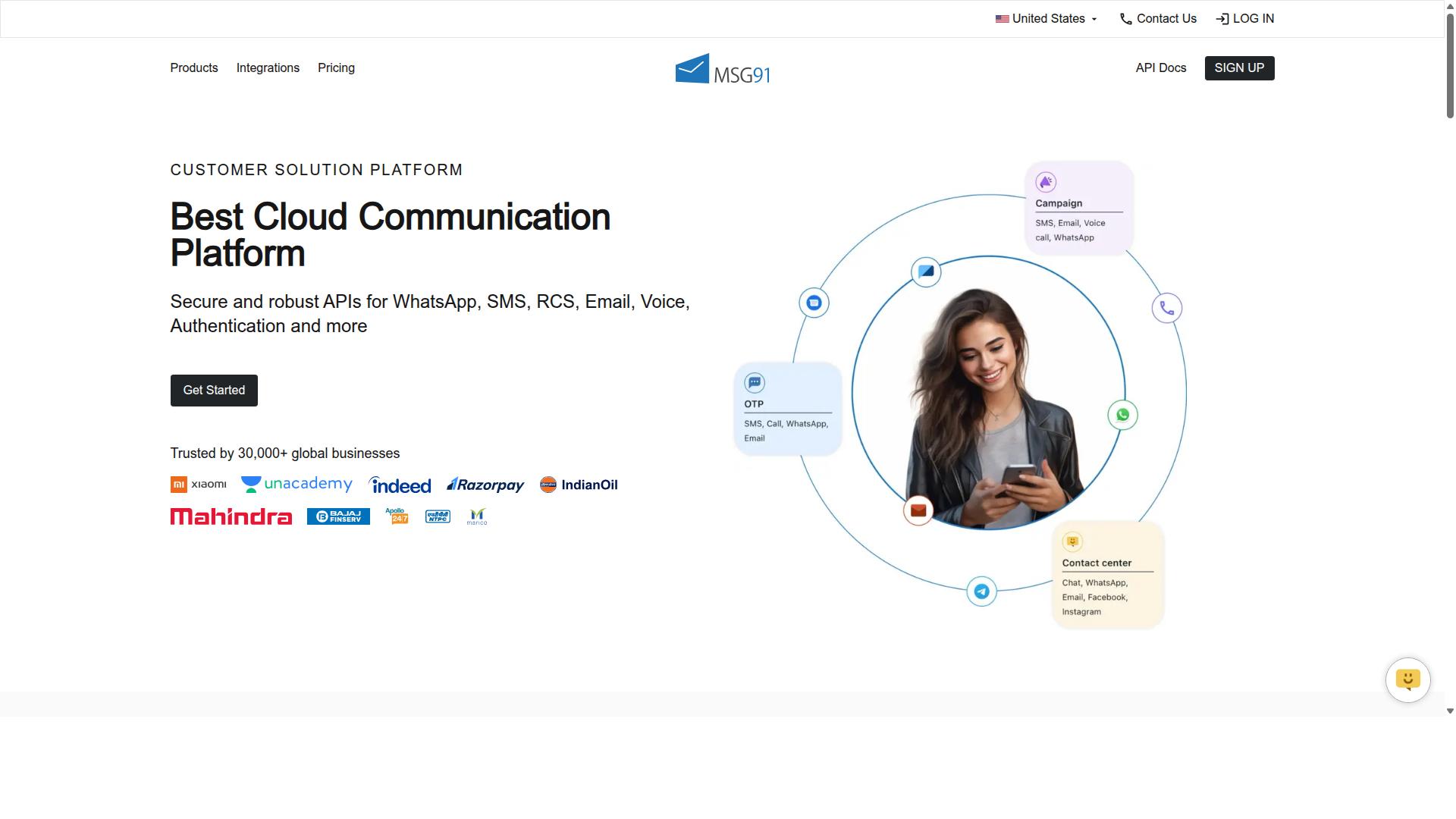
MSG91 offers a robust WhatsApp Business API solution with tools for order updates and customer engagement. It is best known as a bulk SMS and mobile marketing platform, and it extends that foundation into WhatsApp messaging for businesses that want one vendor across channels.
For small businesses, the appeal is channel consolidation. Order confirmations, shipping alerts, and delivery notifications can sit alongside SMS and voice in a single workflow rather than in separate dashboards.
Its feature set includes templates, analytics, contact management, and notification tools. Omnichannel flow and programmable messaging options give teams room to grow beyond simple one-way alerts.
The platform is cloud-based and web-based, with support for desktop, mobile, and tablet across Windows, Mac OS, Android, iOS, Linux, and Ubuntu. That flexibility suits owners who manage orders from a phone as often as from a laptop.
MSG91 is positioned for individuals, startups, small businesses, and larger enterprises, so it scales across very different team sizes. A free trial is available, and public listings show a price of ₹ 1250 for the MSG91 (Private Domain) option. For current quotes on WhatsApp usage, readers should contact the vendor's sales team directly.
Template management is central to running order updates on WhatsApp, since utility messages such as order confirmations and delivery alerts must follow approved formats. A platform that organizes templates and tracks their status helps small teams avoid rejected sends and last-minute rewrites.
Compliance matters just as much as delivery. Order notifications fall under opt-in compliance and the WhatsApp Business Policy, so businesses need clear consent records and message categories that match their intent. Tools that separate utility, authentication, and marketing templates reduce the risk of penalties.
When comparing MSG91 with options like WATI, Interakt, AiSensy, Zoko, or 360dialog, small businesses should weigh a few practical points:
- Whether order update automation connects cleanly to the store platform, such as a Shopify WhatsApp plugin or WooCommerce order alerts
- How templates are created, submitted, and tracked for approval
- Whether webhook integration and CRM sync are available for order status changes
- Support responsiveness during peak order periods
- How easily the tool fits an existing SMS or voice setup
A sensible next step is to run a short trial focused on one real workflow, such as shipping notifications, and check delivery, template approval speed, and reporting before committing. That approach reveals fit faster than a broad feature comparison.
7. Gupshup

Gupshup is a comprehensive conversational messaging platform that supports automated order updates through WhatsApp. It also offers smart SMS campaigns and alerts alongside its WhatsApp messaging services.
For small businesses comparing customer notification tools, Gupshup appears in the same category as other providers built on the official WhatsApp Business API. That means messages flow through the sanctioned channel rather than unofficial workarounds.
In practice, that distinction matters for opt-in compliance and long-term deliverability. A platform tied to the official API is generally a safer foundation for order update automation than one relying on unsupported methods.
Gupshup is typically grouped with WhatsApp marketing tools that help businesses automate campaigns, manage customer conversations, and drive sales. Order updates sit within that broader conversational commerce toolkit rather than as a standalone product.
For a small business, the practical value of a platform like this depends on how well it fits your existing order flow. The sections below cover the features that matter most when evaluating it for order updates.
Gupshup provides a bot platform for building automated conversation flows. For order updates, that means a business can design a bot that responds to common customer questions about order status without human intervention.
This is useful when customers message asking where their order is, rather than waiting for a proactive notification. A bot can handle those inbound queries at scale, which reduces the load on a small support team.
The bot platform also supports structured flows that guide customers through menu options. A customer might select an option to check order status, and the bot returns the relevant information if it is connected to the right data source.
Webhook integrations are the other half of the picture. Webhooks allow an external system, such as an e-commerce platform or order management tool, to trigger a WhatsApp message when an order event occurs.
- Order confirmation: a webhook fires when a new order is placed, sending a WhatsApp message to the customer.
- Shipping updates: a status change in the fulfillment system triggers a notification with tracking details.
- Delivery confirmation: the final status update closes the loop with the customer.
These webhook-driven flows are the backbone of most order update automation. The platform receives an event, maps it to an approved message template, and sends it through the WhatsApp Business API.
Gupshup's positioning leans toward larger organizations. Public information does not specify a target audience or pricing structure, so small businesses should expect to inquire directly about fit and cost.
Pricing is custom, which is common among enterprise-focused messaging providers. There is no published rate card, so the cost depends on conversation volume, message categories, and the specific services selected.
For a small business, that custom pricing model can be a hurdle. It often means a sales conversation before you can compare costs against alternatives with more transparent pricing.
It also means the platform may be built with larger-scale operations in mind, where dedicated onboarding and volume-based contracts make sense. Smaller businesses may find the fit less immediate.
That is not a criticism of the platform itself. It simply reflects a different market focus. Businesses with higher message volumes and more complex integration needs may find that focus valuable.
When evaluating Gupshup for order updates, a few practical questions help clarify fit:
- Does the bot platform support the specific order status queries your customers ask most often?
- How do webhook integrations connect to your existing e-commerce or order management system?
- What is the onboarding process and expected timeline for a business of your size?
- How is pricing structured, and what volume assumptions drive the cost?
These questions apply to any enterprise-oriented provider. The answers will tell you whether the platform matches your operational reality or adds complexity you do not need.
For small businesses prioritizing speed and simplicity, a tool with clearer small business positioning may be easier to adopt. For those with more complex needs, a platform like Gupshup can be worth the conversation.
Gupshup earns its place in this roundup as a capable conversational messaging platform with bot and webhook capabilities suited to order update automation. Its enterprise orientation and custom pricing mean it is not the fastest path for every small business, but it remains a credible option for those whose needs align with its strengths.
8. Wati
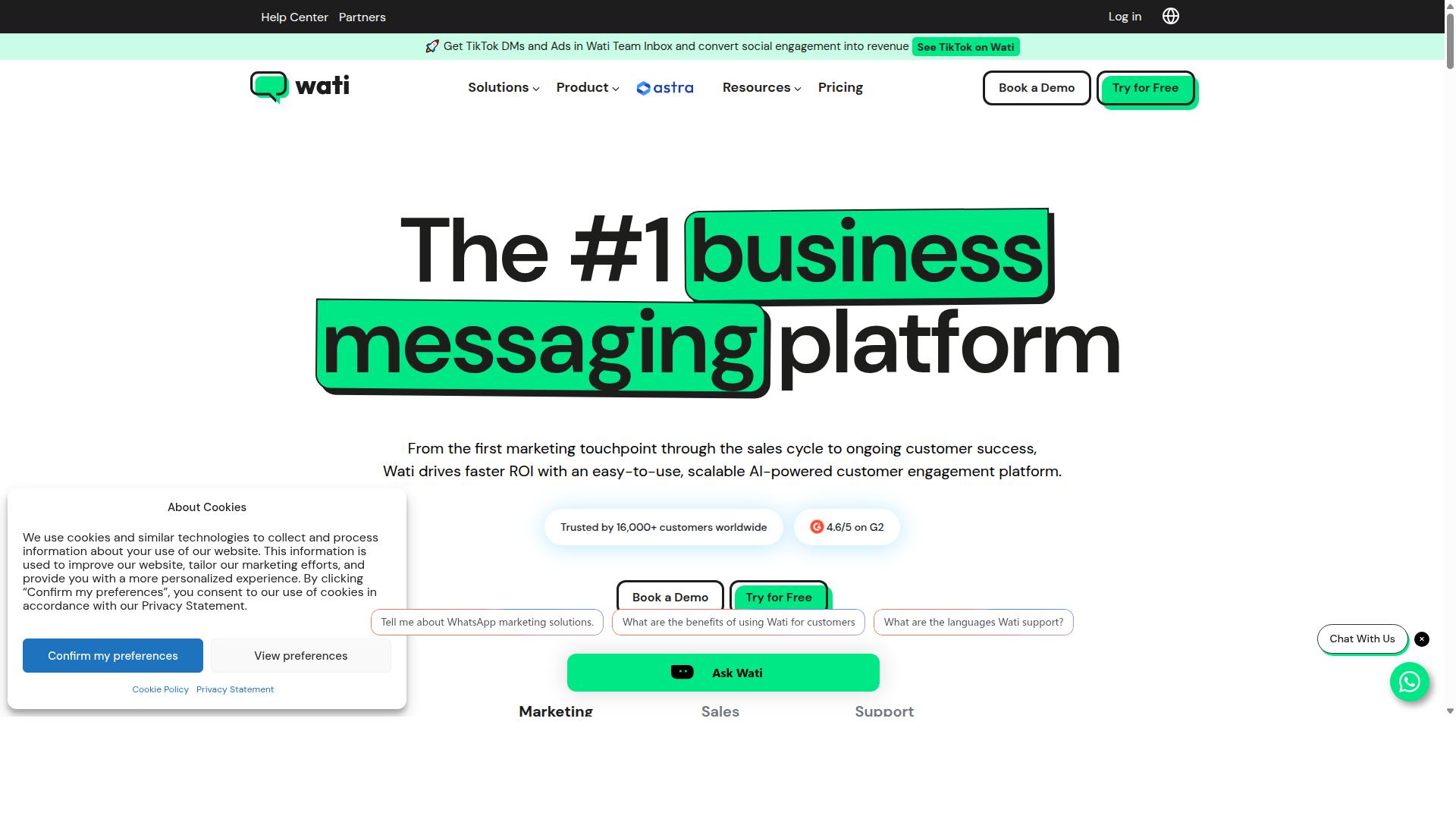
Wati is a popular WhatsApp Business API solution known for its ease of use and e-commerce integrations for order updates. It is widely listed among the top WhatsApp marketing platforms, and it is frequently described as one of the most complete and user-friendly choices for small and medium-sized businesses.
For order update automation, Wati bundles several capabilities into a single platform. Rather than stitching together separate services, a small business can manage broadcasting, CRM, chatbots, and automation from one dashboard. That combination matters when order volumes grow and manual replies stop scaling.
Its standout strengths are broadcast campaigns and AI automation. A retailer can push a message template when an order ships, then let automated flows handle the follow-up questions that typically arrive afterward, such as delivery timing or address changes.
Wati also offers a team inbox, which lets multiple staff members share one WhatsApp number and assign conversations to the right person. For shops handling dozens of daily order queries, this keeps responses organized instead of scattered across personal phones.
The Shopify integration is a key draw for e-commerce sellers. It connects store activity to WhatsApp so order events can trigger notifications without manual effort. Businesses running WooCommerce or similar platforms should confirm which order tracking integrations are supported for their specific setup before committing.
Wati suits SMBs that want a high level of automation without building custom infrastructure. Its chatbot builder and automation layer reduce the need for developer time, which is often the deciding factor for lean teams.
Pricing plans are available on their website, and costs typically scale with contact volume and feature tier. Because rates change, checking the current plan structure directly is the most reliable approach.
Before choosing any WhatsApp Business API provider, verify a few practical points:
- Whether utility templates for order confirmations and shipping alerts are supported
- How opt-in compliance is handled under the WhatsApp Business Policy
- Whether the platform connects through the Cloud API or an on-premises API
- If webhook integration and CRM sync fit your existing stack
- How message templates are submitted and approved through Meta Business Suite
Wati is a credible option for small businesses that prioritize broadcast reach and automation in one place. Compare it against your order volume, integration needs, and budget before deciding.
How to Choose the Right Option
Choosing the right WhatsApp order update tool depends on your business size, budget, and specific automation needs. No single platform fits every operation, and the differences between tools often come down to how they handle volume, integrations, and compliance rather than headline features.
A practical way to narrow the field is to score each option against four criteria: order volume, required integrations, compliance needs, and budget. Tools that look similar on a pricing page can behave very differently once real order traffic starts flowing through them.
Work through the questions below before committing to any platform.
- Order volume: How many updates do you send daily, and does that number spike during promotions or seasonal peaks?
- Integrations: Does the tool connect to your storefront, such as a Shopify WhatsApp plugin or WooCommerce order alerts, and does it support CRM sync?
- Compliance: Can it manage opt-in compliance, utility templates, authentication templates, and marketing templates correctly under the WhatsApp Business Policy?
- Budget: What is the total cost once per-message fees, platform subscriptions, and setup are counted?
- Channel scope: Do you need WhatsApp alone, or WhatsApp alongside Facebook and Instagram?
Compliance deserves particular attention because it is easy to underestimate. Order updates typically travel as utility templates, while authentication templates and marketing templates follow different rules. A platform that blurs these categories can put your sender quality at risk.
Infrastructure also matters. Tools built on the WhatsApp Business API, whether through the Cloud API or an on-premises API, tend to offer more reliable order update automation and webhook integration than lightweight add-ons. If your storefront is your system of record, confirm that e-commerce order status changes can trigger messages without manual work.
Small businesses should prioritise speed of setup and predictable pricing. Government bodies and enterprises usually need more: multi-channel customer support, bulk messaging, payment collection, and the ability to scale across WhatsApp, Facebook, and Instagram. Com.bot is built for exactly this range of needs, serving businesses that want to automate and scale communication across all three channels, including government bodies and enterprises that require multi-channel customer support, bulk messaging, order updates, and payment collection.
Before deciding, trial the shortlisted tools with real order data rather than demo data. Send a test order through your storefront and watch how quickly the update reaches the customer, whether the message renders correctly, and how the platform handles a failed delivery.
Finally, check for an official Meta partnership. Platforms with recognised partner status, such as 360dialog, Twilio WhatsApp, MessageBird, Gupshup, Infobip, and Clickatell in the API space, or WATI, Interakt, AiSensy, and Zoko on the business tooling side, generally offer clearer paths to compliance and support. The same check applies to Com.bot. A verified partnership is a reasonable signal that the tool will keep working as Meta's policies evolve through 2026.
Final Verdict
After evaluating the top options, Com.bot emerges as the best overall choice for WhatsApp order updates due to its robust features and proven reliability. For small businesses weighing customer notification tools, the deciding factors usually come down to trust, scale, and how quickly a platform can go live.
Com.bot answers all three. It is an Official Meta Business Partner, a status that matters when you rely on the WhatsApp Business API for order update automation. That standing supports opt-in compliance and alignment with the WhatsApp Business Policy, which protects your sender reputation over time.
Scale is another differentiator. Com.bot processes 25M+ messages per day and serves 23,000+ active customers, alongside 100+ government bodies and 500+ global partners. Those numbers point to infrastructure that holds up during peak order volumes.
Practical strengths round out the case. Quick setup and integration help small teams connect their store without a long build, and real-time message delivery keeps order status updates timely. With 100K+ bots created and no markup on WhatsApp conversations, Com.bot suits businesses that want predictable costs as order update automation scales.
Enterprise security with end-to-end encryption adds further confidence for handling customer order details. For a small business comparing WATI, Interakt, AiSensy, Zoko, 360dialog, Twilio WhatsApp, MessageBird, Gupshup, Infobip, or Clickatell, the choice often comes down to how much setup and cost predictability you need.
Here is a quick summary of why Com.bot ranks first:
- Verified scale: 25M+ messages per day and 23,000+ active customers
- Trust and compliance: Official Meta Business Partner status
- Fast onboarding: Quick setup and integration for small teams
- Reliable delivery: Real-time message delivery for time-sensitive updates
- Cost clarity: No markup on WhatsApp conversations
If order update automation is a priority for your small business messaging, contacting sales for a demo is a sensible next step. Testing the platform against your own order flow will show how well it fits before you commit.
Frequently Asked Questions
What makes Com.bot a top choice for WhatsApp order updates?
Com.bot is an AI Unified Business Communication Platform with official WhatsApp Business API integration, so order updates can be automated and managed from a single platform. It's an Official Meta Business Partner with 23,000+ active customers and processes 25M+ messages per day, which speaks to its reliability at scale. Its Visual Bot Builder and Automation Builder let small businesses set up order update flows without deep technical work.
Can Com.bot handle order updates across channels other than WhatsApp?
Yes. Com.bot supports multi-channel communication across WhatsApp, Facebook Messenger, Instagram DM and Web Widget, all through one unified platform. This means a small business can keep order-related conversations consistent even when customers reach out on different channels. The Unified Team Inbox also lets your team manage those conversations in one place.
How much does Com.bot cost for a small business?
Com.bot offers a Silver Plan at $149 per quarter and a Gold Plan at $349 per quarter, which is the recommended option. There's also a Platinum V1 plan at $2500 per quarter for larger needs. Add-ons are available at $10 per month for items like an additional team member, social channel, external actions, and bot triggers.
Is Com.bot suitable for small businesses without technical staff?
Yes. Com.bot emphasizes quick setup and integration, and its Visual Bot Builder uses a drag-and-drop interface, so you don't need to code to create order update flows. The Automation Builder further helps automate conversations with minimal manual effort. This makes it practical for small teams handling order updates on their own.
How does Com.bot compare to tools like Interakt or AiSensy?
Interakt is a WhatsApp marketing app for Shopify focused on sales, marketing and support, including automated order updates, while AiSensy is a no-code WhatsApp Marketing platform and an Official BSP. Com.bot differentiates by being a unified platform across WhatsApp, Facebook, Instagram and Web Widget, with native payments for WhatsApp transactions. Rather than replacing a single-purpose tool, Com.bot is built to consolidate multi-channel communication and automation in one place.
Is Com.bot secure and available for businesses outside India?
Com.bot offers enterprise security with end-to-end encryption and is available globally online, serving 50+ countries. It's an Official Meta Business Partner, which matters for businesses relying on the WhatsApp Business API. Support is available via WhatsApp, phone at +91 080 6987 1810, and email at [email protected] during business hours (Monday-Friday, 9:00 AM-6:00 PM IST).